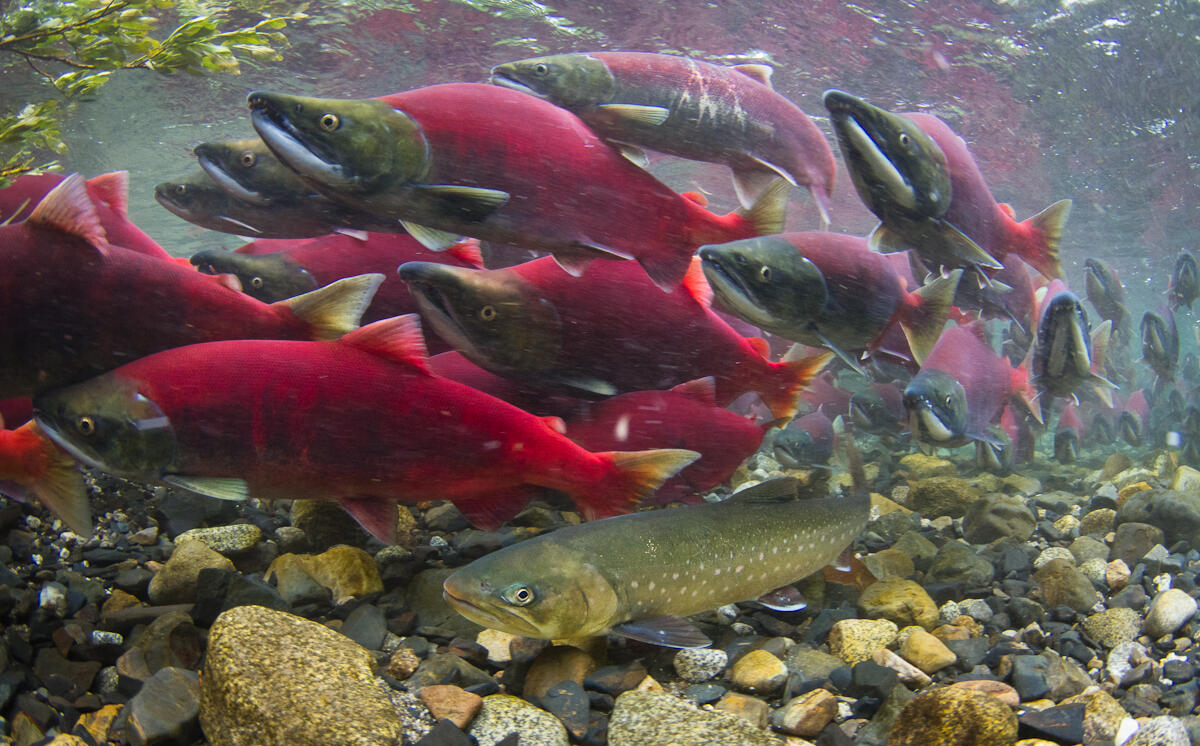
Washington State is home to iconic salmon runs that have long sustained ecosystems, economies, and Tribal communities. Yet, the ability for salmon to thrive has been severely limited by fish passage barriers like culverts, dams, tide gates, and other infrastructure that block access to upstream habitat. Addressing these barriers is central to salmon recovery, climate resilience, and honoring treaty obligations.
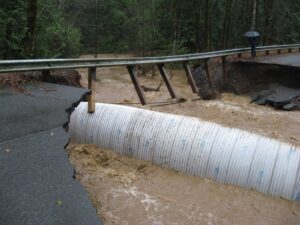
Culvert Swift Creek Thurston County
In response, the Washington State Legislature directed state agencies in 2020 to develop a unified Statewide Fish Passage Prioritization Strategy. Triangle Associates was contracted to lead the facilitation and community engagement component of this legislation.
We led collaboration for the strategy, bringing together Tribes, state agencies, salmon recovery organizations, scientists, and community stakeholders. The strategy development was led by Cramer Fish Sciences, who was responsible for the technical expertise and primary authorship of the strategy.
Working in partnership with the Cramer team, our team’s role was to create the conditions for informed dialogue, shared learning, and inclusive decision-making throughout the development of the strategy.
Our facilitation work included:
- Designing and coordinating meetings with Tribal staff and state agencies, ensuring early feedback opportunities.
- Facilitating a Science Panel that brought together technical experts to assess and recommend approaches to fish barrier prioritization.
- Organizing and hosting two hybrid statewide forums, in Seattle and Wenatchee, to gather public and regional input on the draft strategy.
- Synthesizing stakeholder insights and ensuring transparency and accessibility throughout the process.
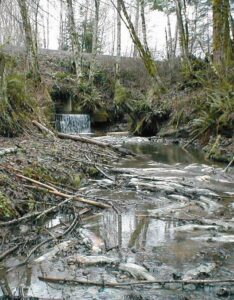
Culvert Lambert Creek Lewis County
From the outset, Triangle prioritized Tribal consultation and regional engagement. Through early coordination with groups such as the Brian Abbott Fish Barrier Removal Board (BAFBRB), regional salmon recovery organizations, and ongoing collaboration with Tribal representatives, we led a process to shape the strategy by those most directly impacted and most experienced in on-the-ground restoration.
Tribal governments were invited to review and respond to drafted strategy materials before they were released to broader audiences, allowing their feedback to influence the strategy prior to broader engagement. Triangle also facilitated the formation and coordination of a Science Panel, which met regularly from September 2023 through May 2024. Our team supported discussions around existing prioritization models, data gaps, and the potential for innovative approaches like mathematical optimization, a method that the Washington Department of Fish and Wildlife (WDFW) is now developing to maximize the impact of future barrier removal investments.
The WDFW Statewide Fish Passage Prioritization Strategy reflects what is possible when facilitation and public engagement are treated as core components of environmental policy making. Through a five-part iterative process including Tribal coordination, stakeholder outreach, science consultation, literature review, and final drafting Triangle helped guide the strategy to completion with transparency, inclusion, and a strong foundation in science and relationships.
We are proud to have partnered with:
- Washington Department of Fish and Wildlife (Dr. Jane Atha, Thomas Jameson)
- Cramer Fish Sciences (Phil Roni, Jason Hall)
- And our Triangle team: Betsy Daniels, Hilary Wilkinson, Kate Galambos, and Cole Dill-De Sa